
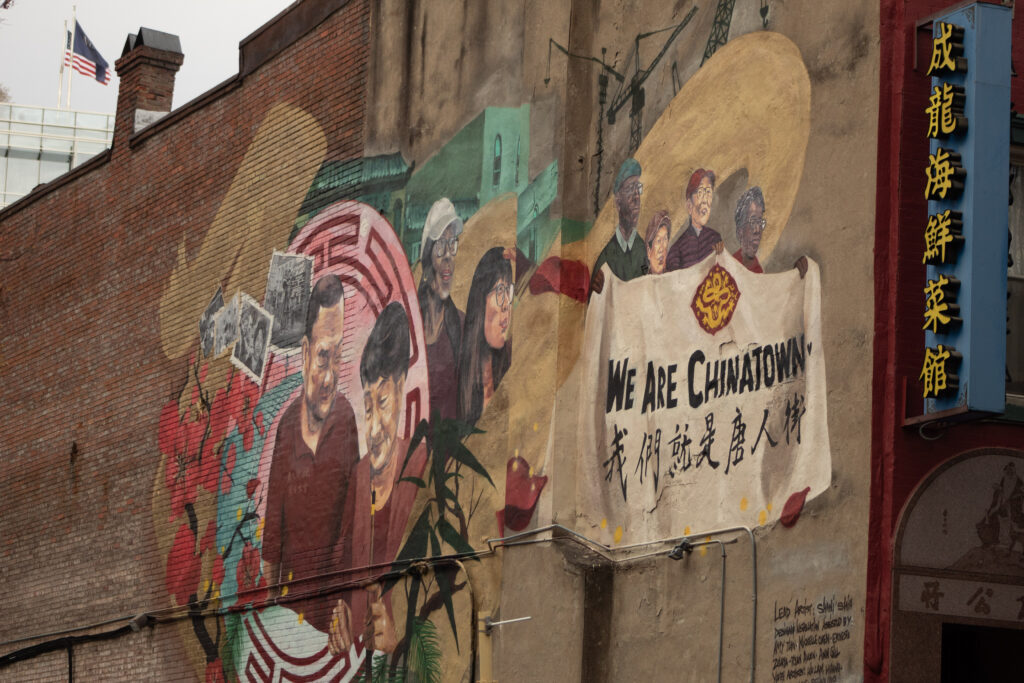
A History of Washington DC’s Chinatown
A short documentary by Avajane Lei
Video Script
Washington, D.C., the nation’s capital, is a place many of you may be familiar with from your middle school field trip or from photos in your AP government textbook.
But beyond the grandeur of the marble monuments, the White House, and the U.S. Capitol, only a few blocks away is D.C.’s Chinese community.
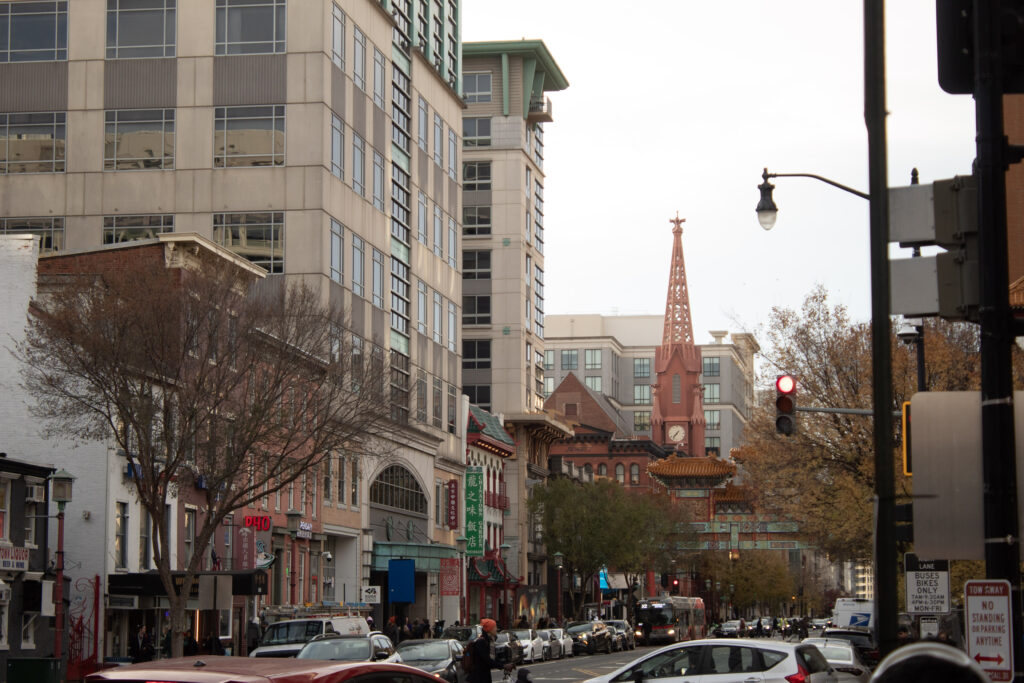
This is Chinatown.
Also known as Gallery Place on the Metro line, unlike its counterparts in major cities such as Chicago, New York City, and San Diego, Washington, D.C.’s Chinatown is compressed into a mere three blocks between H and I Streets and 5th and 8th Streets.
It is a shell of what it once was.
Walking down the streets of Chinatown, you hardly see many Chinese people because most of the DMV Chinese population resides in the suburbs nearby due to suburban flight that took place after the 1960s.
For me, these streets are filled with echoes of memories from the past and tradition, when once a year, the Chinese residents of D.C. and surrounding areas flood the streets for Chinese New Year. Every year, the iconic Chinese New Year parade floats down the streets of Chinatown, and it is a holiday full of color and music—one of the few times a year in D.C. where I feel surrounded by a Chinese community.
But beyond that, most days of the year, Chinatown stands still.
D.C.’s Chinatown is home to the largest Chinatown arch in the United States and is intended to serve as a symbol of the area’s Chinese identity.
However, the area serves more as an example of the dangers of urban renewal and gentrification, driven by systemic racism and erasure, which have heavily defined Washington, D.C.’s history—such as the 1901 McMillan Plan and the 1929 New Deal Public Works project.
For an area so defined by Chinese culture and identity, there are only a handful of Chinese restaurants, which become more and more scarce as the years go by. These restaurants depend on a loyal customer base to resist increasing rent prices over time, but they have been replaced by chains.
There is a large presence of bilingual signage throughout Chinatown, where English chains have their Chinese character translations displayed, their neon signs illuminating the streets at night.
While the presence of bilingual signage could potentially create a sense of embracing the area’s Chinese identity, the truth is that there are currently fewer than 300 Chinese people living in Washington, D.C.’s Chinatown.
It instead creates an idea scholars frequently refer to, stating that D.C.’s Chinatown serves more as an “ethnic theme park.”
The next time you walk down the streets of D.C.’s Chinatown, you may find hidden stories of these displaced Chinese communities that once resided in a greater Chinatown. Their homes may be hidden beneath the rubble cleared for the Wah Luck House, an affordable housing project built in 1982, D.C.’s Convention Center, built in the 1970s, and even the Verizon Sports Center, built in the 90s.
Though these buildings serve as hubs essential to the livelihood of our city overall, they are also puzzle pieces in something greater that has slowly eaten away at D.C.’s Chinatown for decades. But before we can uncover that, let’s go back in time.
In 1851, the first Chinese person registered an address on Pennsylvania Avenue. Throughout the second half of the 19th century, the growing Chinese community consisted of a working middle class of individuals who either immigrated from the Toisan region of China or migrated east from the West Coast after growing tensions between Chinese and white workers.
The Chinese had established their presence on Pennsylvania Avenue, which soon became where D.C.’s Chinatown originally resided, and they served in the workforce as laundrymen and restaurant workers.
By 1884, D.C.’s Chinese population reached about 100 people. When the Chinese Exclusion Act was put into place in 1882, its growth was hindered as the act barred Chinese individuals from immigrating into the United States.
Over time, D.C.’s Chinatown established organizational structures with the creation of family associations, which handled social welfare, while businessmen’s associations known as Tongs handled commercial matters.
These associations helped new members of the community integrate into the new environment, resolve neighborhood grievances, establish Chinese language schools, and serve the needs of the area that were overlooked by the local government.
Throughout the 1920s, speculation created an association between Tongs and criminal activity throughout the city.
Racist policing practices capitalized on this for immigration crackdowns into the 1920s, questioning the legality of the residents in D.C.’s Chinatown.
During this time, the Pennsylvania Avenue Chinatown began to face threats due to the McMillan Plan, introduced in 1902.
The McMillan Plan proposed to turn the city’s central area into a civic park and envisioned a field of grass between rows of grand museums stretching from the U.S. Capitol to the Washington Monument.
This would affect communities that resided along Pennsylvania Avenue, including Chinatown.
Throughout the government, the plan garnered both tremendous support and opposition, and although the McMillan Plan was never fully implemented, it served as a guide for future city planners to create what we know of Washington, D.C.’s central federal areas today.
Eventually, in 1931, the New Deal Public Works Project of 1929 displaced approximately 400 Chinese civilians, and the Pennsylvania Avenue Chinatown, which had resided there for half a century, was cleared for the construction of the Federal Triangle and National Mall projects. The community was resettled to where Chinatown is today, along H Street, only a few blocks away, thanks to the On Leong Tong, which purchased and leased property to 11 affiliated businesses. Henceforth, D.C.’s Chinatown had found its current home.
After the repeal of the Chinese Exclusion Act in 1943 and thanks to familial relationships that connected the Chinese community, the population of D.C.’s Chinatown grew significantly, from 800 to 3,000 by the mid-20th century.
But in 1968, civil rights activist Martin Luther King Jr. was assassinated, only days after he spoke in D.C. about his plans to launch the Poor People’s Campaign.
His death ignited a series of race riots, which involved the rioting, burning, and looting of many businesses and storefronts throughout the city. Some of these businesses, which were Chinese-owned restaurants or laundromats, were left with no choice but to close down for days. This began a wave of population decline as many business owners took the riots as a sign to move to the suburbs, as they no longer felt safe in the city.
This led to a decline in both business and community, as many second-generation Chinese Americans now felt disconnected from the rising crime and taxes in their neighborhood, and they were able to move to the safer suburbs of northern Maryland and Virginia.
Following the race riots of 1968, the city embarked on a mission of urban renewal, which included the construction of a sports and convention center.
The Washington Convention Center was constructed throughout the 1970s and cleared houses on the northwest section of Chinatown, leading to the completion of the Wah Luck House in 1982.
The construction of the sports center in D.C. also displaced even more Chinese residents, who joined others in fleeing to the suburbs, while the elderly population was heavily impacted by these changes. Many remained in Chinatown, occupying the Wah Luck House, which provided seniors with affordable housing.
The uneasiness of these drastic changes in Chinatown prompted the creation of the Chinatown Steering Committee, a city-community effort that demonstrated the common ground of wanting to preserve D.C.’s Chinatown’s cultural significance.
From this collaboration came the Chinatown Design Guidelines Study, which outlined guidelines and standards for redesigning the area to emphasize its “distinctness” and “Chineseness.”
The extensive book helped solidify the boundaries of the neighborhood and envisioned a very Chinese-esque appearance.
The guide is pages and pages of standards for details down to how the signage and doors of buildings, street lights, and landscaping should appear and how to incorporate “Chinese elements” into them. The plan even has a section that proposes specific trees with Asian associations, from ginkgo trees to Japanese katsura trees and Chinese elms.
On top of that, in 1986 came the completion of D.C.’s iconic Chinatown arch, one of the largest in North America. It was designed by Alfred H. Liu, who had also worked on the Wah Luck House. The arch served as a symbol of friendship with Washington’s sister city of Beijing; it was also part of the efforts to solidify the area’s Chinese character.
It was dedicated by D.C.’s mayor at the time, Marion Barry, and Chen Xitong on November 20, 1986.
However, despite all of these efforts to preserve D.C.’s Chinatown as an area of pride for its Chinese community, the efforts have more so backfired.
Instead, over the years, Chinese immigrants who continue to enter the borders of the United States don’t resonate with its artificial, Chinese feel.
The dominating presence of English chains and stores, masked by vibrant colors of red and gold, in addition to the bilingual signage, creates a falsified, polished idea of Chinese identity and occupation of the area.
Without the accompaniment of Chinese-owned businesses and restaurants, and even a strong, noticeable Chinese population roaming the streets, D.C.’s Chinatown begins to feel less and less like a space for the Chinese.
Washington, D.C.’s Chinatown, once a vibrant community rich in history, tradition, and resilience, now stands as a shadow of its former self—reduced to a mere backdrop to the city’s grand monuments and towering skyscrapers. Displaced by cycles of urban renewal and systemic forces, the Chinese community has been steadily pushed to the margins, losing much of its true identity.
As you walk down H Street, past the vibrant neon signs of both English and Chinese-owned
businesses, and through the arch, remember that the community you are walking through has a story of not just loss, erasure, and displacement, but also one of hope, perseverance, and resilience—values that embody the American dream.
In this struggle for survival in the nation’s capital, D.C.’s Chinatown raises a critical question: how does this ethnic enclave reflect the broader Asian American story and identity across the United States, and what does it reveal about what this community could become?
Bibliography
Asch, Chris Myers, and George Derek Musgrove. Chocolate City: A History of Race and Democracy in the Nation’s Capital. University of North Carolina Press, 2017. http://www.jstor.org/stable/10.5149/9781469635873_asch.
“DC Chinatown Walking Tour.” The 1882 Foundation. Accessed December 17th, 2024. https://1882foundation.org/programs/historic-preservation/chinatown-tours/
District of Columbia Office of Planning. Chinatown Design Guidelines Study. Washington, D.C.: District of Columbia Office of Planning, 2020. https://planning.dc.gov/sites/default/files/dc/sites/op/publication/attachments/chinatown_design_guidelines_study.pdf.
“Chinatown; Preserving Our Place” A Right to the City Digital Exhibit. Smithsonian Anacostia Community Museum. Accessed December 17th, 2024.
https://storymaps.arcgis.com/collections/34d99cccb2c5454da7b4f08e482c1987?utm_source=si.edu&utm_medium=referral&utm_campaign=MyVisitSI&item=6
Evening Star. “[Volume].” Chronicling America: Historic American Newspapers, January 8, 1898. Library of Congress. https://chroniclingamerica.loc.gov/lccn/sn83045462/1898-01-08/ed-1/seq-19/.
Evening Star. Evening Star [Washington, D.C.], October 16, 1928. Chronicling America: Historic American Newspapers. Library of Congress. https://chroniclingamerica.loc.gov/lccn/sn83045462/1928-10-16/ed-1/seq-2/.
Evening Star. Evening Star [Washington, D.C.], December 8, 1928. Chronicling America: Historic American Newspapers. Library of Congress. https://chroniclingamerica.loc.gov/lccn/sn83045462/1928-12-08/ed-1/seq-6/.
Evening Star. Evening Star [Washington, D.C.], July 31, 1932. Chronicling America: Historic American Newspapers. Library of Congress. https://chroniclingamerica.loc.gov/lccn/sn83045462/1932-07-31/ed-1/seq-65/.
Evening Star. Evening Star [Washington, D.C.], January 30, 1949. Chronicling America: Historic American Newspapers. Library of Congress. https://chroniclingamerica.loc.gov/lccn/sn83045462/1949-01-30/ed-1/seq-120/.
Lei, Issac. ‘Chinatown.’ 2024, Digital photographs.
Leffler, Warren K, photographer. D.C. riot. April ’68. Aftermath. Washington D.C, 1968. April 8. Photograph. https://www.loc.gov/item/2009632337/.
Leffler, Warren K, photographer. Riot damage in D.C. / WKL. Washington D.C, 1968.
Photograph. https://www.loc.gov/item/2003654397/.
Lin Pang, Ching, and Jan Rath. “The force of regulation in the land of the free: The persistence of Chinatown, Washington DC as a symbolic ethnic enclave.” In The sociology of entrepreneurship, pp. 191-216. Emerald Group Publishing Limited, 2007.
Lou, Jia. “Revitalizing Chinatown into a heterotopia: A geosemiotic analysis of shop signs in Washington, DC’s Chinatown.” Space and culture 10, no. 2 (2007): 170-194.
Pang, Ching Lin, and Jan Rath. The Force of Regulation in the Land of the Free: The Persistence of Chinatown, Washington DC as a Symbolic Ethnic Enclave, 2006.
Takagi, Paul, and Tony Platt. “Behind the gilded ghetto: An analysis of race, class and crime in Chinatown.” Crime and Social Justice 9 (1978): 2-25.
Vitiello, Domenic, and Zoe Blickenderfer. “The planned destruction of Chinatowns in the United States and Canada since c. 1900.” Planning Perspectives 35, no. 1 (2020): 143-168